
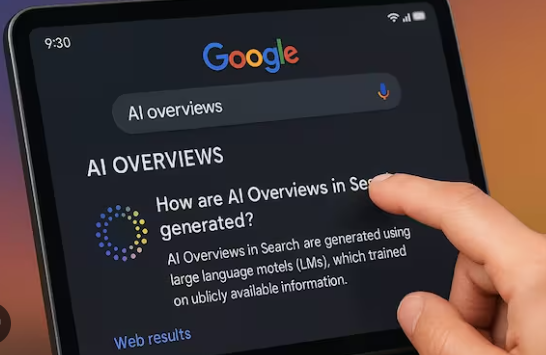
Search is changing fast. Google’s AI Overviews have introduced a new way of displaying information. “AI Overviews” that combines artificial intelligence with traditional search signals to deliver instant, summarized answers right at the top of the results page.
This evolution is transforming how users interact with content, how websites gain visibility, and how SEO professionals must adapt. Success now depends on understanding how these AI impact on SEO and summaries work, what factors influence their appearance, and how to structure content so it can be selected and featured.
Let’s explore the changing dynamics of AI Overviews and the strategies you can use to stay visible in this new landscape.
AI Overviews Have Reduced Nearly 33% of Search Clicks
AI Overviews have become a regular part of the search experience. Early research showed a rapid increase in the frequency of AI Overview appearances.
Within just six months, their presence in search results tripled in some markets. These summaries are designed to give users quick, conversational answers without requiring them to click through multiple links.
This convenience, however, comes with a shift in how people consume information. Click-through rates for both organic and paid listings have dropped significantly on searches that include AI Overviews.
While users still engage with content, they often find what they need directly within the summary itself. AI Overviews appear in nearly 74% of problem-solving or question-based searches.
For industries like science, health, education, and social topics where people frequently ask detailed informational questions, the impact has been especially strong.
“Zero Clicks” Searches Account Over 60% of Searches
AI Overviews have changed not only search rankings but also user behavior. A growing share of users now rely on these summaries for quick answers. Only a small percentage consistently click on the linked sources.
In fact, “Zero Clicks” searches now account for over 60% of all Google searches, and AIO is the main reason. This doesn’t mean visibility no longer matters but quite the opposite.
Appearing as a cited source in an AI Overview boosts your brand authority and recall no matter if fewer users click through. Visibility now equals credibility. The challenge lies in earning that mention.
Users appear to trust AI-generated summaries, especially when they sound clear, factual, and balanced. This makes quality, factual accuracy, and content structure more important than ever.
What Makes AI Overview Choose Websites as a Source?
While no one outside Google knows the full algorithmic details, several patterns have emerged from observation and large-scale analysis.
1. Strong Organic Performance Still Matters
Most links featured within AI Overviews already belong to pages ranking in the top ten results for the same query. This means traditional SEO fundamentals like keyword optimization, backlinks, and domain authority remain extremely important. High rankings still signal trust and reliability to Google’s systems.
2. Structured and Organized Content
AI models need clear signals to identify relevant information quickly. Pages that use structured formats (like tables, lists, FAQs, or brief answer boxes) are easier for Google to interpret.
Clean HTML structure and schema markup improve how algorithms extract key information.
For example, marking up product reviews, FAQs, or how-to guides helps AI systems understand your content’s context and purpose.
3. Factual and Expert Content
Accuracy is invaluable. Google’s ranking systems reward content that demonstrates experience, expertise, authoritativeness, and trustworthiness (E-E-A-T). This is especially true for sensitive topics like health, finance, or science.
AI Overviews prefer information that comes from knowledgeable sources written in a clear, factual tone. Well-researched articles that avoid speculation and focus on reliable, verifiable information tend to perform better.
Content Structure and Strategy for AIO Optimization
The structure of your content can determine whether your site appears in an AI Overview or not.
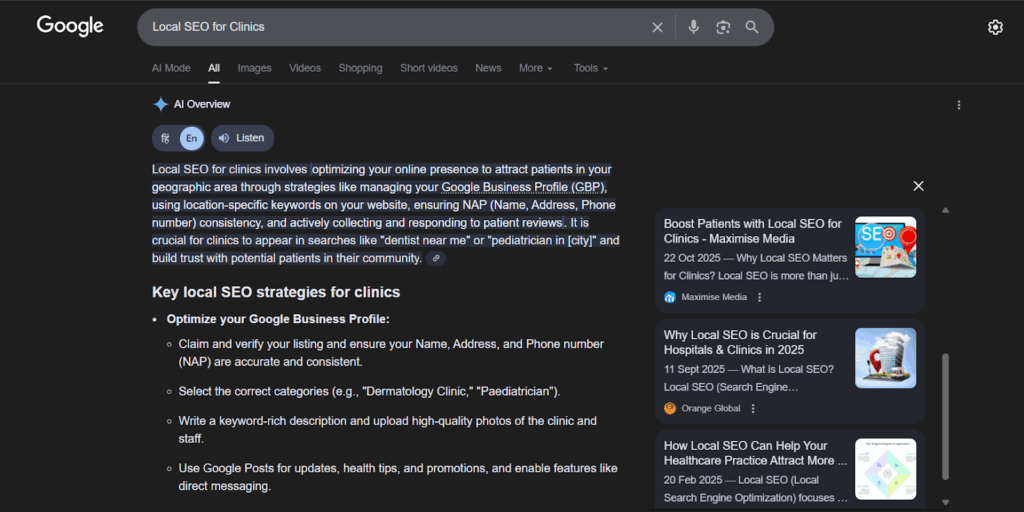
01.) Begin with Direct, Useful Answers
Start your article or section with a brief, factual summary that directly addresses the user’s question. Think of it as a “quick answer” or “key takeaway” box that delivers immediate value.
Example: If the query is “What is vitamin D deficiency?”, a strong opening might be: “Vitamin D deficiency occurs when the body doesn’t get enough vitamin D to maintain bone and immune health. It can result from limited sunlight exposure or poor diet.”
This type of clear, short, and factual statement increases the likelihood of your content being cited in a summary.
02.) Use the Q&A and Listicle Format
AI Overviews favor content that mirrors natural language questions. Incorporating questions as headings (like “What are the benefits?” or “How does it work?”) helps the algorithm connect your page with user intent.
Similarly, list formats (“Top 5 reasons,” “Steps to follow,” “Common mistakes”) make your information easier to scan and summarize.
03.) Focus on Entities, Not Just Keywords
While keyword optimization remains important, AI systems also identify entities like specific people, places, concepts, or things. Building topic clusters around these entities helps search engines understand your expertise.
For instance, an article about “skin hydration” could link to related entities like “hyaluronic acid,” “moisture barrier,” and “dermatologist tips.” These internal connections signal depth and authority on the topic.
04.) Refresh and Maintain Content
AI models favor recent and relevant information. Updating your articles with new data, examples, or insights every few months helps maintain visibility. Add updated statistics, refine explanations, and ensure all claims remain accurate and supported.
Technical SEO Practices That Support AI Overviews
Optimizing for AI Overviews is not just about writing. The technical foundation of your site plays a vital role.
1. Schema Markup
Using schema helps search engines understand the purpose of each content block. Examples include:
- FAQ schema for question-based content.
- HowTo schema for instructional guides.
- Review schema for feedback or product analysis.
Schema doesn’t guarantee inclusion, but it greatly increases eligibility by clarifying context.
2. Clean and Accessible HTML
Avoid excessive code or heavy scripts that slow down your site. AI systems prefer pages that load quickly and render properly on both desktop and mobile.
Ensure that your headings (H1, H2, H3) are used logically, reflecting content hierarchy. Proper structure improves readability and extractability.
3. Mobile Optimization and Speed
Since most searches occur on mobile, your website must perform smoothly on smaller screens. Fast loading, minimal pop-ups, and accessible navigation all improve the likelihood of AI inclusion.
4. Secure and Reliable Hosting
A stable, secure (HTTPS) site helps build user trust and signals credibility to search engines. Websites that load in less than 3 seconds not only help chances to get cited by AI overviews, but also help normal SEO ranking.
How Build Trust Through Content for AI Overview?
Even though AI Overviews summarize information, user trust still depends on where that information comes from.
01.) Write for Clarity and Neutrality
AI systems are trained to prefer neutral, factual content. Avoid exaggerated claims, complex jargon, or emotionally charged language. Instead, focus on clear explanations supported by data or expert consensus.
02.) Display Author Expertise
Whenever possible, include short author bios or reference credentials. Even if AI Overviews don’t show this information directly, it strengthens your credibility signals in Google’s systems.
03.) Use References Wisely
Instead of stuffing external links, cite only trustworthy sources that support your claims. A few well-chosen references signal authority without overwhelming the reader.
04.) Maintain a Consistent Publishing Standard
Regularly updated blogs or resources signal that your site is active and reliable. Consistency helps establish a trustworthy reputation over time.
How to Measure AIO Optimization Impact?
With AI Overviews now common, traditional metrics like click-through rate (CTR) tell only part of the story.
a.) Monitor Brand Visibility
Even when fewer users click links, appearing in AI summaries increases exposure. Track impressions, mentions, and branded searches to measure this indirect benefit.
b.) Observe Shifts in Traffic Patterns
Compare traffic from informational queries versus transactional ones. You may find that while clicks drop for general questions, conversions improve on deeper pages.
c.) Adjust Your Strategy
If your industry shows a high rate of AI Overview presence, prioritize structured informational content. For low-impact areas, continue focusing on transactional intent and long-tail keywords.
d.) Use Behavioral Insights
Tools that show user paths, dwell time, or engagement levels can help you understand how people interact with your pages after viewing an AI Overview.
What’s Working Best in AIO 2025-26?
Based on ongoing experiments and content performance across multiple sectors, the following trends stand out:
- Informational depth matters more than word count. Articles that fully answer the “why” and “how” of a question are favored.
- Entity-based optimization is outperforming keyword stuffing. Creating clusters of related topics signals expertise and thematic strength.
- Trust signals are decisive. Transparency, author credibility, and factual tone directly affect inclusion.
- Visual and structured formats enhance extractability. Charts, lists, and tables make it easier for AI systems to quote your content.
- Continuous content refreshes outperform static pages. Updated posts maintain visibility longer and attract re-indexing.
- User-centric design improves selection chances. Sites with clear navigation and fast load times consistently appear in summaries.
The Future of SEO in an AI-Driven Search
The introduction of AI Overviews marks the biggest evolution in search since the rise of featured snippets. This shift means SEO is no longer just about ranking but about representation in summarized, AI-driven answers.
In the coming years, expect Google’s systems to become more conversational, context-aware, and multimodal. Content that integrates text, visuals, and structured data will gain an advantage.
Marketers, content creators, and businesses must move beyond chasing individual keywords. The goal is to create holistic, interconnected topic ecosystems built on authority, clarity, and trust.
Success will depend on three key pillars:
- Factual, expert-led writing.
- Technical precision and structured presentation.
- Ongoing adaptability to search evolution.
AI-driven search doesn’t eliminate SEO but it refines it. Visibility now depends less on manipulation and more on mastery of clear, high-value communication.
Final Thoughts
AI Overviews are influencing how information flows across the web. They reward the most relevant, organized, and trustworthy content. While click rates may fall, the opportunity to become a cited, trusted source in the world’s most-used search engine is more valuable than ever.
The best strategy moving forward is to build for both humans and machines:
- Write to serve real user needs.
- Structure content for easy comprehension.
- Keep information current, accurate, and balanced.
In a context where AI shapes the first impression of your content, credibility and clarity are your most powerful assets.
Work with Top Healthcare SEO Agency in Delhi NCR
Maximise Media is a top healthcare SEO agency in Delhi NCR that helps clinics, hospitals, and medical practitioners rank on top medical search results. We use an AI-first strategy to develop content optimized for patients and search engines both. We have worked with 250+ clients and are working with over 40+ at present.
Our team excels at optimizing clinical websites to build topical authority, increase traffic, and generate organic leads. In fact, one of our clients, which is an IVF hospital, generates over 500 leads monthly and over 50,000 monthly traffic organically without spending a penny on ads.
If you’re looking for the same result for your clinic, brand, practice, hospital, or wellness center, get in touch with us.