
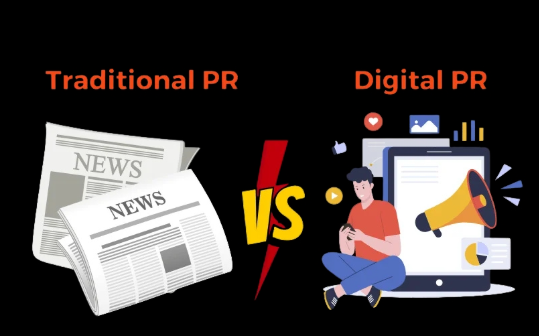
Public Relations (PR) helps brands build awareness, credibility, and trust. Traditionally, PR focused on newspapers, television, and radio to shape public perception through one-way communication. It created a reputation but offered limited reach and measurable impact.
However, PR has now evolved into a data-driven practice. Digital PR blends storytelling with analytics, using online publications, social media, influencers, and SEO to engage audiences directly. It allows real-time interaction, targeted visibility, and measurable business results.
The transformation from traditional to digital PR marks a shift from media dependence to online influence. This leads to a key question for modern businesses: How does Digital PR differ from Traditional PR, and how does it shape business growth and reputation today?
Let’s Understand:
Traditional PR: The Foundation of Brand Credibility
Traditional PR focuses on offline communication and personal relationships with journalists and editors to shape public opinion and strengthen brand reputation. It relies on trusted media like newspapers, magazines, radio, and television to deliver credible third-party visibility through press events and interviews.
Its approach is formal and one-way, aimed at broad audiences to maintain authority and consistency. Traditional PR builds lasting credibility and public trust, especially in sectors like healthcare and finance. However, it can be costlier, slower to show results, and more difficult to measure compared to the real-time analytics and precision offered by digital PR.
Digital PR: The Modern Growth Engine for Businesses
Digital PR is the modern, data-driven evolution of traditional public relations. It integrates SEO , online media, and influencer marketing to build visibility, authority, and measurable engagement. Unlike traditional methods, it focuses on results such as traffic, leads, and brand reputation.
Operating across blogs, news sites, podcasts, and social media, Digital PR delivers real-time visibility and lasting impact. Each online mention or backlink strengthens search authority and customer trust. In sectors like healthcare and eCommerce, it boosts traffic, credibility, and conversions, making it one of the most powerful and scalable growth tools for modern businesses.
Differences Between Digital PR and Traditional PR
While both share the goal of building credibility and awareness, the difference between Digital PR and Traditional PR lies in their approach, channels, and measurable outcomes. Traditional PR focuses on offline reputation and relationship building, while Digital PR emphasizes online visibility, audience targeting, and data-backed impact.
| Aspect | Traditional PR | Digital PR |
| Channels | Print, TV, radio | Online media, social, influencers |
| Targeting | Broad, general audience | Data-driven, niche audience |
| Communication | One-way | Two-way, interactive |
| Speed | Slow, event-based | Instant, real-time |
| Longevity | Temporary coverage | Evergreen digital visibility |
| Measurability | Limited | Fully trackable (traffic, backlinks, ROI) |
These distinctions make Digital PR vs Traditional PR more than just a shift in platforms. It’s a transformation in strategy. Digital PR combines speed, precision, and measurable outcomes, giving brands the power to reach specific audiences, adapt campaigns instantly, and build lasting visibility in an increasingly online-first world.
Impact of Digital PR on Businesses
Digital PR has become a performance-driven strategy that links brand storytelling with measurable business results. It not only boosts online reputation but also directly influences visibility, traffic, and conversions through data-backed and SEO-integrated campaigns.
1. SEO and Organic Growth
Digital PR is deeply connected to search engine optimization. When reputable websites link back to a brand, Google sees those backlinks as votes of confidence, improving the site’s authority and rankings.
Case studies show measurable success: A SaaS client achieved a 34% increase in organic traffic within three months, while a fintech client saw 42% growth in six months.
On average, active Digital PR campaigns contribute 10–15% of a brand’s total organic traffic, proving their direct role in sustained search visibility and long-term business growth.
2. Building E-E-A-T (Experience, Expertise, Authoritativeness, Trust)
Google’s E-E-A-T principles reward brands that demonstrate credibility and expertise. Digital PR strengthens these signals by positioning company representatives as trusted experts through interviews, guest features, and authoritative mentions.
Each publication or digital mention adds to the brand’s online footprint, showing both users and search engines that the business is reliable and knowledgeable. Over time, this improves not just ranking potential but also user trust. It is especially valuable for healthcare, finance, and other high-trust industries.
3. Traffic and Conversions
Digital PR doesn’t just build awareness. It drives measurable engagement. A well-executed PR placement can deliver over 1,000 referral visits, creating direct traffic spikes from credible publications.
Additionally, brands often experience a 6–12% increase in branded search queries after high-quality media coverage. These visits are more qualified and more likely to convert because they come from audiences who already associate the brand with authority and reliability.
4. Measurability and ROI
One of the strongest advantages of Digital PR is its transparency in performance tracking. Around 64% of brands now use analytics tools like GA4 to measure outcomes such as traffic, backlinks, and domain authority growth. The most valued KPIs include link quality (87%) and domain rating (84%).
Compared to traditional PR, Digital PR offers faster visibility into ROI, lower operational costs, and clearer insights into which campaigns drive real business results, which makes it a smarter, data-led investment for modern brands.
How Does Traditional PR Support Digital PR?
The relationship between Traditional PR and Digital PR is not competitive but complementary. When both are aligned, they create a powerful, unified communication strategy that enhances visibility, credibility, and trust across all channels.
Building Credibility That Fuels Online Trust
Traditional PR creates the foundation of brand credibility through trusted media coverage in newspapers, magazines, and television. These third-party mentions show authority to audiences and even to search engines. When digital teams promote these stories online, they gain more visibility and trust. This makes traditional credibility the base for a strong digital reputation.
Amplifying Visibility Through Cross-Channel Impact
When integrated properly, traditional and digital PR strengthen each other’s results. A print or television feature can increase online searches, social media discussions, and reviews. Likewise, a popular digital story can attract attention from mainstream media. This cross-channel amplification helps brands stay visible both offline and online.
Real-World Example: Healthcare and eCommerce Success
For healthcare clinics, a newspaper story about patient safety can lead to more Google searches and positive online reviews, improving reputation and search ranking. In the same way, eCommerce brands that combine influencer campaigns with press coverage gain two types of trust. Emotional connection from audiences and authority from traditional media.
The Integration Gap and the Growth Opportunity
Despite clear benefits, only about 14.5 percent of digital PR teams currently collaborate closely with traditional PR professionals. This gap limits the full potential of both. Businesses that merge both approaches see stronger brand recall, consistent communication, and measurable growth. True success in PR comes from integration and not separation.
Industry Insights: Why Businesses Are Prioritizing Digital PR?
The PR landscape has undergone a major transformation, with businesses shifting budgets and strategies toward digital-first approaches. From improved ROI to AI integration, Digital PR is becoming the preferred choice for brands that seek measurable growth, visibility, and relevance in competitive industries.
1. Growth Trend: The Rise of Digital PR
Interest in Digital PR has surged by nearly 34% globally since 2020. This growth reflects how brands now recognize the importance of online visibility, SEO integration, and real-time engagement. The expansion of digital media, influencer platforms, and search-driven storytelling has made Digital PR a core part of modern marketing strategies rather than a supporting function.
2. Investment Efficiency and Cost Advantage
Compared to traditional campaigns, Digital PR offers higher returns at lower costs. The average contract ranges between $5,000 and $10,000 per month, while traditional PR often costs $10,000 to $14,500. This efficiency allows even mid-sized businesses to access high-quality exposure without heavy financial strain. Digital tools also reduce manual work, enabling faster content distribution and campaign optimization.
3. ROI Insight: Proving Real Business Impact
More businesses are seeing PR as a direct driver of growth rather than a passive branding tool. Around 67% of CMOs confirm that PR influences revenue performance, while integrated strategies combining traditional and digital approaches can raise total business revenue by up to 20%. From storytelling to a scalable growth lever that connects visibility with profitability, this measurable impact has redefined PR’s role
4. AI and Future Tools: Redefining PR Efficiency
Artificial intelligence is now a central part of PR operations. Nearly 75–80% of professionals use AI tools for ideation, media monitoring, and campaign analytics. Additionally, 64% rely on AI-powered writing and tracking systems for accuracy, speed, and performance evaluation. These technologies help teams analyze trends, personalize outreach, and measure results faster. It allows brands to stay relevant and data-driven in a fast-moving digital space.
5. Sector Relevance: How Industries Leverage Digital PR
Different industries are embracing Digital PR in unique ways:
- SaaS and Technology: Prioritize link-building, online authority, and search-driven visibility.
- Healthcare: Use Digital PR to enhance trust, reputation, and patient education through credible publications.
- eCommerce: Focus on influencer collaborations and content placements that drive conversions and brand loyalty.
By aligning Digital PR strategies with sector-specific goals, businesses maximize both visibility and trust. Thus, it creates a strong foundation for sustained digital growth.
The Future: Digital-First PR with a Human Touch
The future of PR is unmistakably digital-first, yet its heart remains human. As algorithms and AI continue to evolve, authenticity, credibility, and emotional storytelling will define brand success. Businesses must build insight-driven PR systems that merge data with empathy. This uses analytics to guide strategy without losing the human connection that earns trust. The brands that thrive will balance automation with authenticity and visibility with value.
At Maximise Media, a top healthcare digital marketing agency in India, our Digital PR approach combines SEO, content intelligence, and meaningful storytelling to help brands stay visible, credible, and connected in an ever-evolving digital landscape.
Aditya Bharadwaaj, founder and CEO at Maximise Media, said, “In sectors like healthcare, Digital PR isn’t just communication. It’s conversion with credibility.”
Book a free strategy call with Maximise Media and find out how Digital PR, SEO, and performance marketing can help your clinic or hospital reach more patients.